Hostile Courtroom Architecture
I believe a space shapes an event. The living room furniture influences the flow of a party. The orientation of a garden affects the harvest. The theatre alters the performance. The ancient arts of Vasthu and Feng Shui are all about organizing spaces for optimal spiritual and psychological benefits. What does this say about legal spaces?
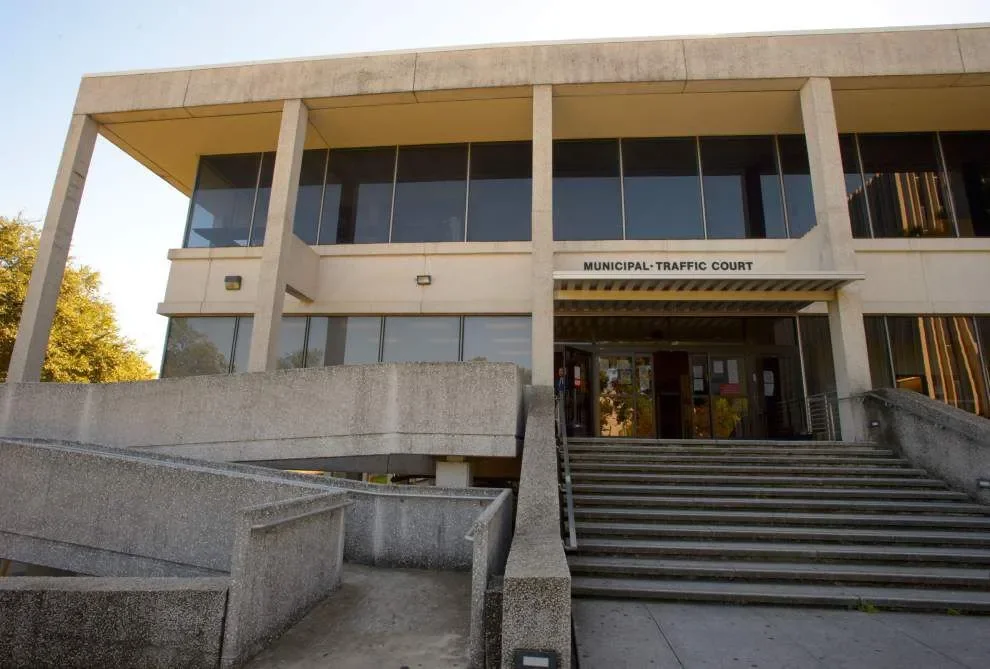
The New Orleans municipal court was the first courtroom I really spent extended time inside, and it’s the space which got me thinking about the link between architecture and legal rights. It is a concrete building, pretty brutalist in style, but without the grand scale. It is very short and wide. Visitors must take many steps across a courtyard and ascend a few decorative staircases to get to the front entrance from the curb.
The setup of a New Orleans municipal courtroom is pretty standard for American courts. There are wooden benches for the spectating audience filling half of a large room, almost like a church. The pews/benches are rigid and glossy under a thick layer of varnish and fluorescent lighting. If you sit on them for several hours at a time in the course of observing court or waiting for your case to be called, the curved edges of the bench dig into the back of your thighs, and you have to jiggle your legs to keep them from falling asleep.
At the front of the room is a large desk for the judge, clerks, and a court reporter. It’s actually more of a command center than a desk. It is massive, multi-segmented, typically covered in stacks of case files, wired up with microphones, and significantly elevated compared to the rest of the courtroom.
In the no man’s land between the pews and the judge’s table, there is a slender podium with a microphone and two simple tables on either side of it. One table for defense counsel and one for the prosecutor. On the side closer to defense counsel’s table, there is a jury box.
The jury box contains a few shorter pews with their backs facing a side wall. A wooden bannister cordons off the rectangular section and serves as a low barrier between the jury box and the rest of the courtroom. During misdemeanor arraignments (a defendant’s first appearance before a judge after being arrested), no jury is seated, so incarcerated defendants are brought to sit in the jury box while the judge works through the arraignment calendar one by one. The jury box, then, acts as a mini jail visually separating those who are incarcerated from the spectating audience and the defendants who could afford to bond out. Without fail, the free people in the courtroom sit closer to the door.
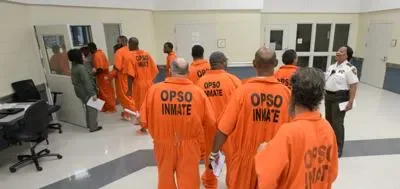
Inmates of the Orleans Parish Sheriff’s Office line up to go to arraignments
The incarcerated defendants are brought in through a back entrance (or a front entrance, depending on your perspective) which is behind the judge’s chair. These defendants are brought over straight from the jail across the street. I’ve seen them brought in while they are still linked together by metal chains and ankle cuffs. They all wear identical orange jumpsuits.
One by one, as they are called forward for their case, a bailiff unchains them from one another so that they may briefly speak to their attorneys and, sometimes, to the judge. They do not go to the podium. Incarcerated defendants make their comments standing in the jury box, while those sitting next to them look at the floor, at their fingernails, at the far wall. They look anywhere but their fellow inmate who is leaning sideways, craning his neck for a moment of eye contact, pleading a futile case to a judge on high.
The difference in outcomes between a defendant making their case from the jury box and a defendant able to approach the podium is stark. At least, it seems stark to someone who has seen it play out hundreds of times before. One gets their bond set at $10,000— an inconceivable price for pre-trial liberty. The other gets a slap on the wrist. It plays out like this with depressing consistency.
While these outcomes are obviously different, and in many cases, life-changing, the difference in the eyes of the law is virtually nonexistent. By law, these two hypothetical defendants are “similarly situated.” Practically speaking, it is precisely their differing situations in the physical space which makes all the difference to their legal outcomes.
The subtlety with which architecture influences legal proceedings makes it hard to blame for inequitable outcomes. Technically, a defense attorney could always request that their client be brought out of the jury box during a hearing. Or a judge may insist upon it as a matter of personal preference. There is nothing demanding the dehumanizing separation in the courtroom. It just happens. But the thing is, it happens a lot. And there isn’t always a way to circumvent every physical or architectural disadvantage.
The jury-box-turned-jail, the impersonal architectural style of a courthouse facade, the limited and uncomfortable seating, the courthouse entrance which encumbers wheelchair users, and many other architectural and design features of courts do influence and exacerbate subconscious biases. If this weren’t the case, we wouldn’t have the ADA and similar policies which impose minimum (read: insufficient) requirements of accessibility for government buildings. And, if the benefits of a physical common ground weren’t so crucial, lawyers around the country would not have fought so hard to keep courts open throughout the pandemic. Even the language of legal disputes (and legal fiction) is rife with spatial metaphors. There is just something about sharing space which makes a judicial proceeding more fair, more human.
Unfortunately, besides an ADA complaint, there are very few ways for litigants or for the public to enact change upon the physical spaces housing the legal system. And, it’s hard to argue that revamping the decor should be the most urgent task for any judicial body right now, even if it will make people feel more welcomed, included, and accommodated. Nonetheless, I think it is important that all attorneys take a page from disability advocates and recognize how physical spaces have a profound impact on our lived realities and our jobs. Architecture and design may be negatively impacting our clients and even the integrity of our proceedings. Just as we would object to a hostile witness, we must be willing to name and object to hostile architecture.
——————
author’s note: this was written based on my recollections of the New Orleans Municipal Court and the New Orleans Jail from when I worked there in 2016. Maybe it has changed since then. Who knows? I haven’t particularly desired to go back to visit.